


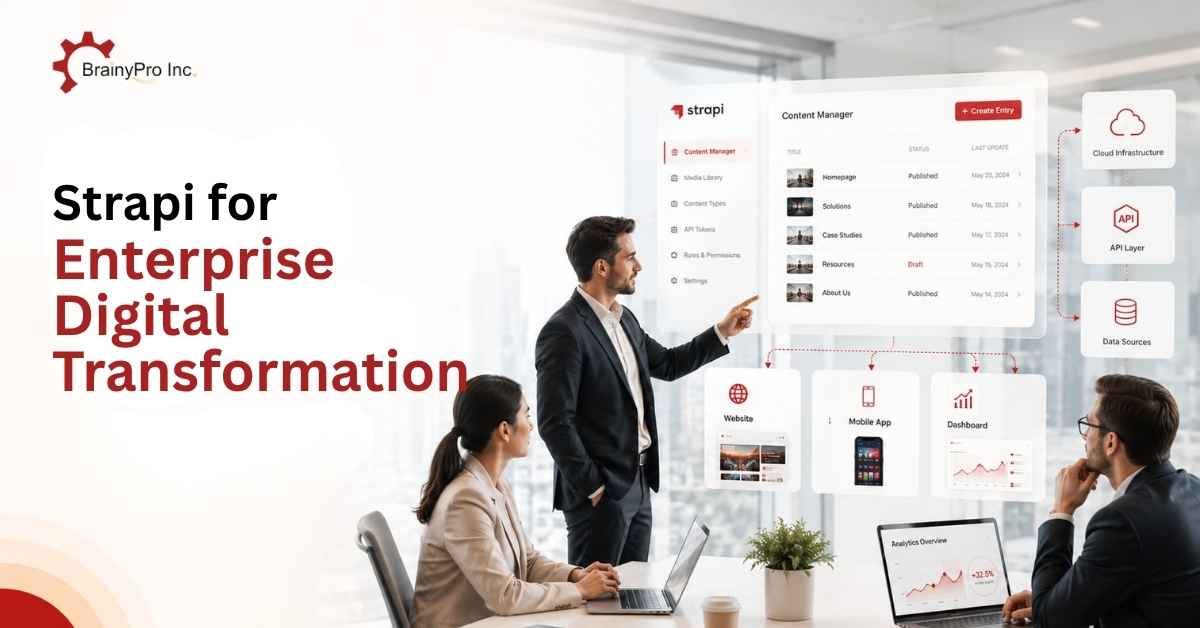
In the intensely competitive digital economy, businesses must not fall behind in modernizing operations. They must streamline content management and deliver seamless experiences across multiple platforms.
Traditional content systems are often rigid, slow, and unable to support rapid scaling. This limits growth and customer engagement. Strapi provides a flexible CMS solution designed to support digital transformation initiatives.
By separating content from presentation, it allows for seamless integration and customization. That enables integration with modern tools and processes. Organizations adopting Strapi can accelerate development and optimize content delivery. They can also build adaptable systems that evolve along with their transformation strategies.
Businesses use websites, mobile apps, e-commerce platforms, and internal portals. Managing content across multiple channels requires a CMS platform that centralizes operations. It should also give teams control over how content is delivered.
By implementing Strapi, businesses gain a headless content management system that can handle complex workflows. That improves user satisfaction and supports long-term growth. With Strapi, businesses can experiment with new digital touchpoints and integrate with third-party services. They can also continuously adapt to changing market requirements.
They can leverage analytics and monitor user interactions. They can also gather valuable insights to make informed decisions that enhance business outcomes. The flexibility of this system allows organizations to respond quickly to market changes and launch new campaigns. They can also provide timely content updates that align with the overall strategy.
Why Businesses Need Strapi for Digital Transformation
Digital transformation is critical for companies to remain competitive. Businesses struggle with outdated systems that limit growth. They also increase operational complexity and slow overall efficiency. By adopting a headless CMS, organizations can streamline processes and reduce manual work. They can also quickly respond to evolving market demands. Modern digital strategies allow teams to centralize content management. They also maintain flexibility for innovation and multi-platform distribution.
Organizations can optimize internal processes and operational flows. They can adopt automation, simplify approvals, and reduce repetitive tasks. That can free employees to focus on strategic initiatives. Companies can also experiment with personalization, aligning with user preferences and behavioral patterns. With proper transformation strategies, businesses gain operational efficiency. They also reduce costs associated with outdated technology. That can create a more agile environment capable of addressing evolving challenges.
Challenges with Traditional Systems
Traditional platforms slow down updates and complicate content management. Development cycles lengthen, and content management poses challenges. These bottlenecks hinder collaboration, delay product launches, and reduce engagement. In addition, older CMS systems often lack modern security protocols, analytics, and integration capabilities. That forces organizations to rely on multiple disconnected tools, increasing operational complexity.
Traditional systems also struggle to handle simultaneous content updates across diverse platforms. This makes it difficult to maintain consistency and accuracy. Teams are often forced to duplicate efforts, manually update information, and troubleshoot inconsistencies. These can lead to errors, delays, and customer dissatisfaction. Modern organizations require CMS solutions that separate content logic from design, optimize operations, and allow agile responses. That helps to adapt to evolving business requirements.
Benefits of Scalable Transformation Approaches
Adaptable systems are essential for growth. With Strapi, organizations can deploy platforms that support high-traffic applications, distributed teams, and complex processes. Flexible solutions reduce dependency on backend developers, improve content consistency, and allow teams to deliver digital content efficiently. Modern strategies empower businesses to maintain competitiveness, optimize resources, and future-proof operations. By adopting scalable solutions, businesses can also plan for expansion without major system overhauls. That reduces both time and costs associated with growth.
Furthermore, these approaches allow organizations to handle spikes in traffic or introduce new product lines. As a result, they can expand into new markets. This happens without the need for costly infrastructure upgrades or prolonged development timelines.
How Strapi Benefits Your Business
Strapi is an API-first CMS designed to enable businesses to modernize content management and accelerate transformation initiatives. Its headless CMS architecture separates content from presentation, giving teams flexibility and control to deliver digital assets efficiently.
By adopting Strapi, organizations gain a system that improves operational efficiency and supports high-performance frontend delivery. It integrates seamlessly with existing tools. Additionally, Strapi enables content reuse across platforms, making it easier to maintain consistency and scale operations without repetitive work.
Implementing such solutions enables organizations to improve team collaboration and reduce communication gaps. They also allow developers and content managers to work simultaneously without waiting for sequential processes.
Understanding Strapi’s Headless CMS Architecture
A headless CMS like Strapi decouples content from its presentation. This allows developers and content teams to work independently. This separation allows rapid deployment, reduces operational bottlenecks, and guarantees timely delivery across touchpoints. Businesses can model content efficiently, maintain structured data, and build processes tailored to their operational needs. Simultaneously, they can maintain consistency across platforms. By implementing a headless CMS architecture, teams can experiment with innovative design approaches and create personalized user experiences. They can quickly adapt content for multiple touchpoints.
This independence fosters creative freedom. It also reduces reliance on specialized development staff for routine tasks. As a result, project delivery accelerates, and the overall agility is enhanced.
API-First Architecture
Strapi follows an API-first architecture, exposing APIs to interact with existing systems and external services. This allows seamless integration with CRMs, ERP platforms, analytics tools, and marketing automation software. Teams can leverage RESTful and GraphQL APIs to accelerate production and reduce bottlenecks. They also maintain flexibility for customization or software development projects.
Organizations benefit from predictable data flows and efficient operations. They can rapidly adapt to changing customer needs and introduce new features. API-first architecture also allows teams to standardize development processes and enforce best practices. It also helps create reusable modules. As such, businesses can reduce duplication and maintain consistency across projects.
Flexible Content Management
With Strapi, businesses gain full control over content management, creating models, workflows, and publishing rules that match unique operational requirements. Teams can manage content independently from the frontend, improving collaboration and minimizing bottlenecks.
Strapi’s headless CMS guarantees content consistency, enhancing overall satisfaction while reducing dependency on developers for routine updates. Teams can also experiment with dynamic content structures, creating more personalized experiences without compromising efficiency. Furthermore, flexibility allows marketing and product teams to rapidly implement campaign strategies, launch promotions, and respond to market trends effectively.
Workflow Optimization
Strapi improves operational efficiency by streamlining content creation, approvals, and distribution. Teams can automate repetitive tasks, shorten production cycles, and implement processes that deliver content to digital touchpoints faster while maintaining quality and compliance standards. Optimized workflows allow marketing, product, and development teams to collaborate seamlessly. This reduces friction and guarantees every update aligns with business goals. Detailed reporting and analytics can be incorporated into workflows, providing visibility into content performance and engagement for continuous improvement.
Faster Content Delivery
With Strapi, content is delivered efficiently across platforms. Its lightweight, API-driven framework provides fast frontend rendering and minimal latency. This supports web applications, mobile apps, and e-commerce systems. Rapid delivery enhances engagement, conversions, and operational efficiency. This efficiency also allows organizations to scale quickly, support seasonal traffic spikes, and provide high-performance experiences to end users. Additionally, organizations can implement caching strategies, optimize media assets, and distribute content in multiple formats. That way they can cater to diverse audience requirements.
Strapi for Integration and Scalability
Strapi provides seamless integration with existing systems, enabling organizations to connect external services such as analytics, marketing automation, and legacy platforms. Its API development capabilities allow teams to build digital products efficiently, reduce bottlenecks, and scale operations without compromising performance. The platform supports growth, giving teams confidence that operations will evolve alongside organizational needs. Organizations adopting Strapi benefit from faster production timelines, reduced technical debt, and more predictable project outcomes. Integration also facilitates centralized monitoring, allowing IT teams to quickly identify and resolve issues across multiple platforms and services.
Customization and API-First Approach
Strapi offers a customization layer that lets developers build solutions tailored to specific processes. Its API-first approach allows developers to leverage APIs for seamless integrations, automate repetitive tasks, and deliver digital content quickly. Organizations can also extend functionality with custom plugins, creating systems tailored to their operational requirements. This flexibility allows teams to innovate faster, reduce dependency on external vendors, and maintain control over critical business processes. The customization also enables content editors to design their own templates, fields, and content types to support diverse operational needs.
Multi-Channel Content Delivery
Strapi delivers content efficiently. Organizations can synchronize updates across mobile apps, web applications, and e-commerce platforms. This reduces duplication, improves quality, and allows customers to access timely information across all digital touchpoints. By centralizing operations, organizations can focus on strategy and personalization rather than troubleshooting delivery issues. Teams can also track version history, schedule content releases, and implement automated processes for targeted audiences. It ensures content remains relevant and timely.
Strapi Cloud and Security
Strapi Cloud provides a managed hosting option for faster deployment, scalability, and secure operations. The system supports role-based access control, enabling secure collaboration for distributed teams. Organizations maintain full control over their data, while teams benefit from improved performance, reliability, and compliance with security standards. With Strapi Cloud, IT teams can focus on innovation rather than server management or maintenance. Security monitoring, automated backups, and activity auditing maintain compliance with internal policies and regulatory requirements, reducing risk and operational overhead.
Headless CMS Benefits for Digital Transformation
Strapi entails the following benefits for businesses:
Content Modeling and Governance
Strapi’s headless CMS benefits include robust content modeling, governance, and structured solutions that allow teams to build adaptive systems. With flexible structures, organizations can adapt management processes to support modern strategies and optimize production time. Governance features also guarantee content complies with internal policies and organizational workflows, enhancing reliability and security. Detailed modeling allows teams to define complex hierarchies, relationships, and metadata, supporting personalization and data-driven decision-making.
Improved User Experience Across Platforms
By separating content from presentation, Strapi ensures a consistent experience across digital platforms. Teams can rapidly deploy updates, maintain high performance on frontend interfaces, and provide content integrity across websites and mobile apps. Enhanced experiences increase customer satisfaction, brand trust, and engagement metrics, driving long-term value. Additionally, improved responsiveness and cross-device consistency strengthen accessibility, allowing users to interact with content seamlessly regardless of device or location.
Accelerating Digital Transformation Initiatives
Strapi enables organizations to streamline operations, reduce production cycles, and accelerate successful initiatives. Its headless content management system allows teams to focus on innovation, optimize delivery, and implement processes. These improve operational efficiency and customer engagement. By centralizing content management, companies can experiment with AI-driven automation, personalized experiences, and real-time analytics, further enhancing initiatives. The system also supports rapid testing and iteration, allowing teams to continuously refine strategies based on performance metrics.
FAQs
#1. What is Strapi, and why is it important for digital transformation?
Strapi is an open-source headless CMS that separates content from presentation. It allows teams to streamline management, optimize delivery, and support transformation initiatives efficiently. Organizations gain operational benefits and flexibility.
#2. How does Strapi integrate with existing tools and platforms?
Strapi’s architecture supports integration with web applications, mobile apps, CRMs, and analytics tools. It guarantees smooth data flow, reduces production cycles, and enables efficient operations with minimal friction.
#3. Can Strapi improve content management workflows?
Yes, Strapi centralizes management, automates tasks, and provides flexible content modeling. Teams improve collaboration, shorten production timelines, and deliver content consistently across platforms, enhancing operational efficiency.
#4. Is Strapi suitable for e-commerce and mobile applications?
Absolutely. Strapi supports platforms and mobile apps, enabling multi-channel publishing, a consistent experience, and faster content delivery. Teams can manage campaigns and inventory updates efficiently.
#5. How do organizations benefit from Strapi’s headless CMS?
Strapi’s system allows customization, API integration, and multi-channel delivery. Enterprises gain efficiency, reduce bottlenecks, and accelerate initiatives while maintaining control over workflows and content.
Conclusion
Modern organizations seeking transformation need CMS solutions that are flexible, scalable, and future-ready. Strapi delivers a headless CMS architecture that optimizes workflow, delivers content across multiple platforms, and integrates with existing systems.
By adopting Strapi, businesses can accelerate production cycles and enhance overall experience. They can achieve efficient management across web applications, mobile apps, and e-commerce platforms.
Investing in Strapi allows organizations to reduce operational bottlenecks, scale efficiently, and achieve long-term success. The adoption of advanced workflows, content automation, and multi-platform distribution ensures agility. It also helps organizations remain innovative. That way, they can handle future challenges while consistently meeting customer expectations.